
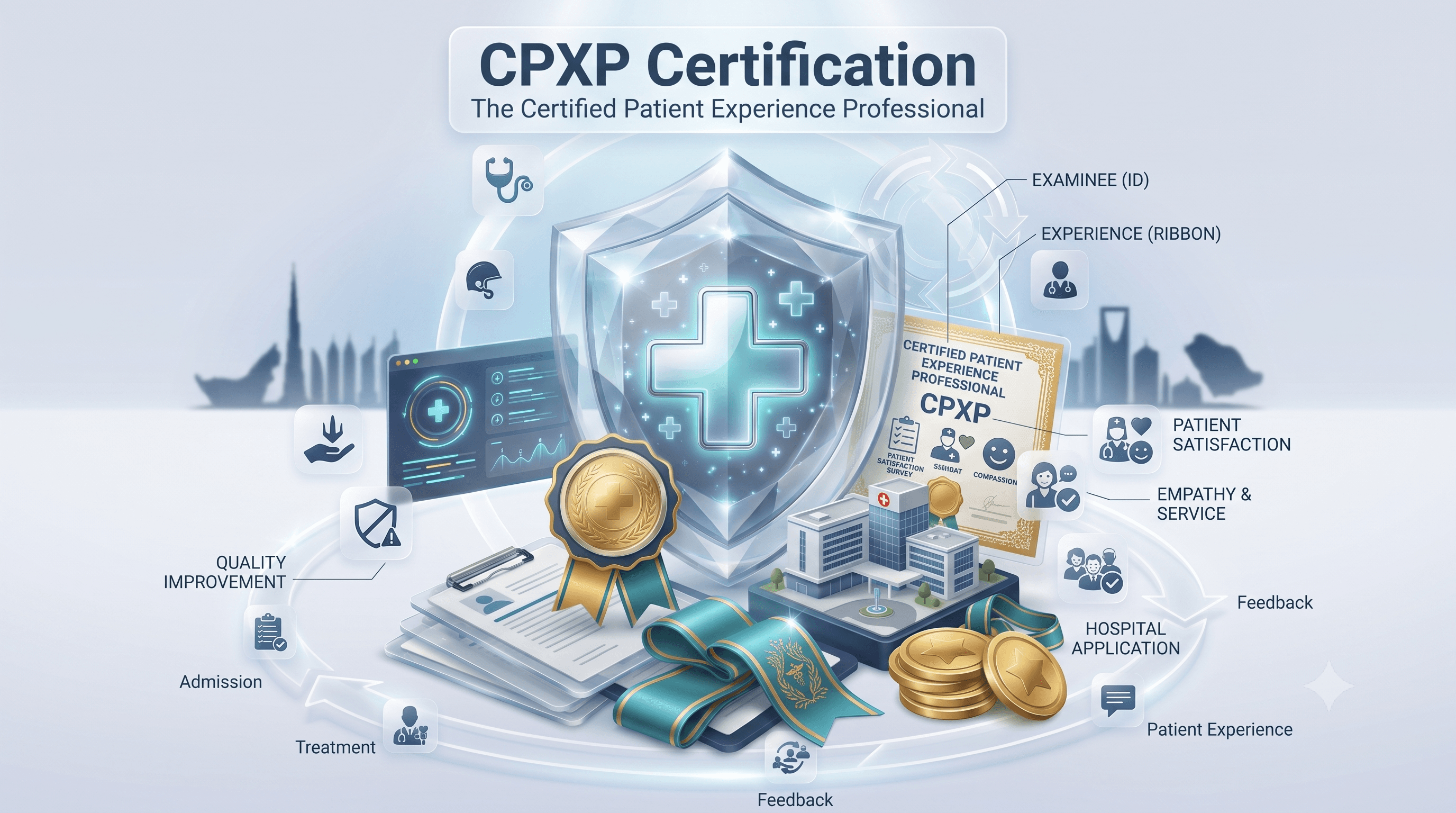
Healthcare is increasingly judged not only on clinical outcomes but on how patients experience their care — and a dedicated profession has grown up around improving it. The CPXP (Certified Patient Experience Professional) is the credential that recognises expertise in this field. This guide explains what the CPXP is, who awards it, what the exam covers, who's eligible, and why patient experience is a rising specialty across the region.
What is the CPXP?
The CPXP is awarded by The Beryl Institute, the leading global community for patient experience. It certifies that you have the knowledge to lead patient-experience work — partnering with patients and families, measuring and analysing experience, designing better experiences, and shaping the organisational culture and leadership that make good experience possible. It marks you as a credible patient-experience professional in a field that's becoming central to healthcare quality.
The CPXP exam
| Element | Detail |
|---|---|
| Questions | 150 multiple-choice questions |
| Time | 3 hours |
| Delivery | Testing centre or online live proctoring |
| Cost | approx. $475 |
| Validity | 3 years |
The four content domains
The exam is organised around four domains:
- Partnership and advocacy — engaging patients, families and staff as partners.
- Measurement and analysis — capturing and interpreting experience data.
- Design and innovation — improving and redesigning the experience of care.
- Organizational culture and leadership — embedding experience across the organisation.
Confirm the current content outline in The Beryl Institute's CPXP handbook.
Who is eligible for the CPXP?
The CPXP is accessible to committed professionals. Candidates typically qualify with at least three years of experience in a patient-experience or related healthcare role, or by completing 30 Patient Experience Continuing Education credits (PXEs) if they don't yet have the three years — a flexible route that lets newer professionals build eligibility. Confirm current requirements with The Beryl Institute.
Recertification
The CPXP is valid for three years, renewed by earning 30 PXEs (including continuing education). As with the other credentials in this family, the model rewards staying professionally active rather than sitting a fresh exam every cycle.
Why patient experience matters
Patient experience has moved from a soft extra to a core measure of healthcare quality — linked to better clinical engagement, stronger reputation and, in competitive markets, patient choice. As GCC and Egyptian health systems modernise and compete (including for medical tourism), skilled patient-experience professionals are increasingly in demand. The CPXP is the credential that formalises this expertise, and it complements safety and quality credentials like the CPPS and CPHQ.
Ready to lead patient experience? IMETS helps you prepare for the CPXP with practical, bilingual training — explore the program.
Why patient experience is now a strategic priority
Patient experience has moved from a 'nice to have' to a strategic and clinical priority. Evidence links better experience to better clinical engagement, adherence and outcomes; and in competitive or medical-tourism markets, experience directly shapes patient choice and reputation. GCC health systems in particular have invested heavily in experience as part of modernisation. The CPXP formalises the expertise behind this work, turning what was once seen as 'customer service' into a recognised professional discipline with its own methods and evidence base.
How the CPXP complements safety and quality
Patient experience isn't separate from safety and quality — it's deeply intertwined with them. A patient who feels heard is more likely to raise a safety concern; a well-designed, compassionate process is usually a safer one too. That's why many professionals pair the CPXP with a CPPS or CPHQ: experience, safety and quality reinforce each other, and expertise across them makes for a well-rounded, influential quality leader.
Frequently Asked Questions
Who awards the CPXP certification?
The Beryl Institute, the leading global community for patient experience, awards and administers the CPXP through its credentialing centre.
What does the CPXP exam cover?
Four domains: partnership and advocacy; measurement and analysis; design and innovation; and organizational culture and leadership — 150 questions in 3 hours.
What are the CPXP eligibility requirements?
Typically three years of experience in a patient-experience or related role, or completion of 30 Patient Experience Continuing Education credits (PXEs) if lacking the experience. Confirm with The Beryl Institute.
How long is the CPXP valid?
Three years, renewed by earning 30 PXEs including continuing education.
Prepare for the CPXP with IMETS
View the Quality Management Diploma