
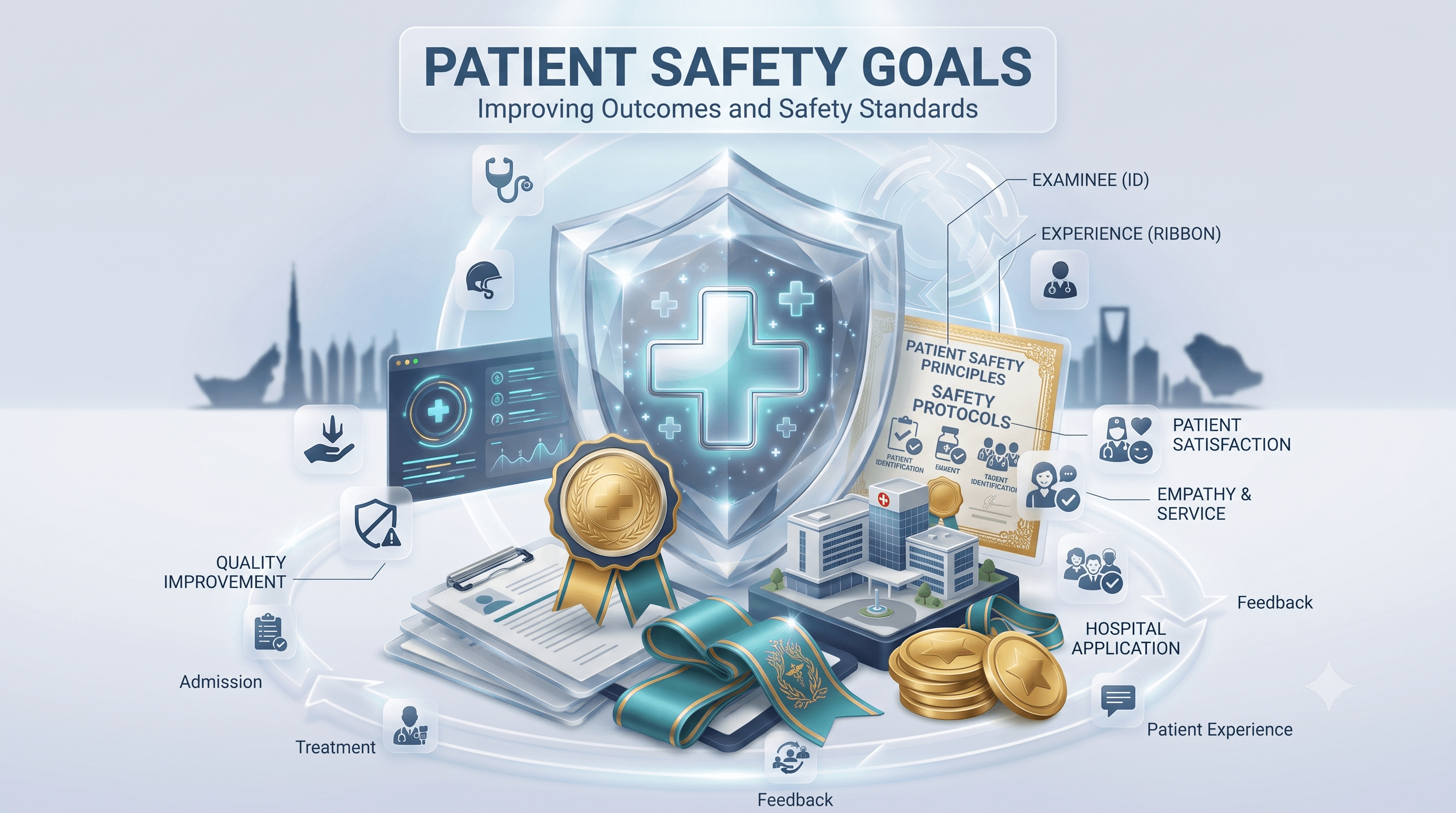
Patient safety rests on two pillars: clear goals that focus effort on the highest-risk areas, and a culture in which those goals can actually be met. This guide covers both — the internationally recognised patient safety goals every healthcare worker should know, and the just, learning culture that turns them from posters on a wall into how a hospital really works.
The International Patient Safety Goals (IPSG)
The most widely used framework is the International Patient Safety Goals (IPSG), established by Joint Commission International and embedded in accreditation systems worldwide. There are six, and together they target the areas where patients are most often harmed:
- Identify patients correctly — using at least two identifiers before care, procedures and medication.
- Improve effective communication — especially for verbal orders and critical results and at handovers.
- Improve the safety of high-alert medications — managing the drugs most likely to cause serious harm.
- Ensure safe surgery — correct patient, correct site, correct procedure, with a surgical safety checklist.
- Reduce the risk of healthcare-associated infections — through hand hygiene and infection prevention.
- Reduce the risk of patient harm from falls — assessing and mitigating fall risk.
These aren't abstract ideals — they're the practical priorities surveyors check and the areas where reliable practice saves the most lives. Every one connects to daily work: the identity check before a transfusion, the timeout before an incision, the fall-risk assessment on admission.
Why goals need a culture to succeed
Goals alone don't create safety; people working within a supportive culture do. You can mandate a surgical checklist, but whether it's used meaningfully — every time, by a team that speaks up — depends on culture. That's why patient safety and safety culture are inseparable, and why the CPPS devotes an entire domain to culture.
What a strong safety culture looks like
A mature safety culture has recognisable features:
- Psychological safety — staff feel safe to speak up about risks and errors without fear.
- Reporting is welcomed — near-misses and errors are treated as learning, not ammunition.
- Leadership visibly prioritises safety — in words, resources and their own behaviour.
- Teamwork and communication — clear, respectful communication across hierarchies.
- Learning, not blaming — the focus is on fixing systems, not punishing individuals.
Just culture: balancing accountability and learning
At the heart of modern safety thinking is just culture — a framework that rejects both the old blame culture (punish the individual) and a blameless free-for-all (ignore all accountability). Instead, just culture distinguishes between human error (console and support), at-risk behaviour (coach and understand why the shortcut felt reasonable), and reckless behaviour (which does warrant accountability). The genius of just culture is that it makes reporting safe — and without honest reporting, an organisation is blind to its own risks.
The test of a just culture: when something goes wrong, does the organisation ask "who did this?" or "what in our system allowed this to happen, and how do we fix it?" The second question is where safety improves.
From incidents to improvement
A safety culture turns adverse events and near-misses into fuel for improvement. When something goes wrong, the response isn't to find someone to blame but to understand why — which is exactly what root-cause analysis is for (see our RCA guide). Each event analysed and each system weakness fixed makes the next patient safer. This is the everyday work of patient-safety professionals, and the reason the field is so impactful.
Want to lead patient safety with real depth? IMETS training builds the safety-culture and improvement expertise the field demands — and prepares you for the CPPS. Explore the program.
Turning safety goals into daily habits
The gap between knowing the patient safety goals and living them is where most harm hides. Turning goals into habits means embedding them into everyday workflow so the safe action is the default: two identifiers built into every eMAR scan, a surgical timeout that can't be skipped, a fall-risk assessment triggered automatically on admission. The best safety programmes design the environment so that doing it right is easier than doing it wrong — reducing reliance on memory and vigilance, which always fail eventually.
Measuring safety culture
You can measure culture, not just outcomes. Validated safety-culture surveys (asking staff whether they feel safe to speak up, whether errors lead to learning or blame, whether leadership prioritises safety) give a picture of where a culture stands and how it's changing. Tracking these alongside incident-reporting rates — where, counterintuitively, more reporting often signals a healthier culture — helps safety leaders see beneath the surface and target their efforts.
Frequently Asked Questions
What are the International Patient Safety Goals?
Six JCI goals: identify patients correctly; improve effective communication; improve high-alert medication safety; ensure safe surgery; reduce healthcare-associated infections; and reduce the risk of patient harm from falls.
What is a just culture in healthcare?
A framework balancing learning and accountability — supporting staff for human error, coaching at-risk behaviour, and holding reckless behaviour accountable — so that reporting errors is safe and systems can improve.
Why is safety culture important?
Because safety goals and checklists only work if people apply them reliably and speak up about risks. A strong culture — psychologically safe, learning-focused — is what makes safe practice consistent.
How do patient safety goals relate to accreditation?
Frameworks like JCI, CBAHI and GAHAR embed patient safety goals into their standards, so meeting them is essential for accreditation as well as for protecting patients.
Build safety expertise with IMETS training
View the Quality Management Diploma